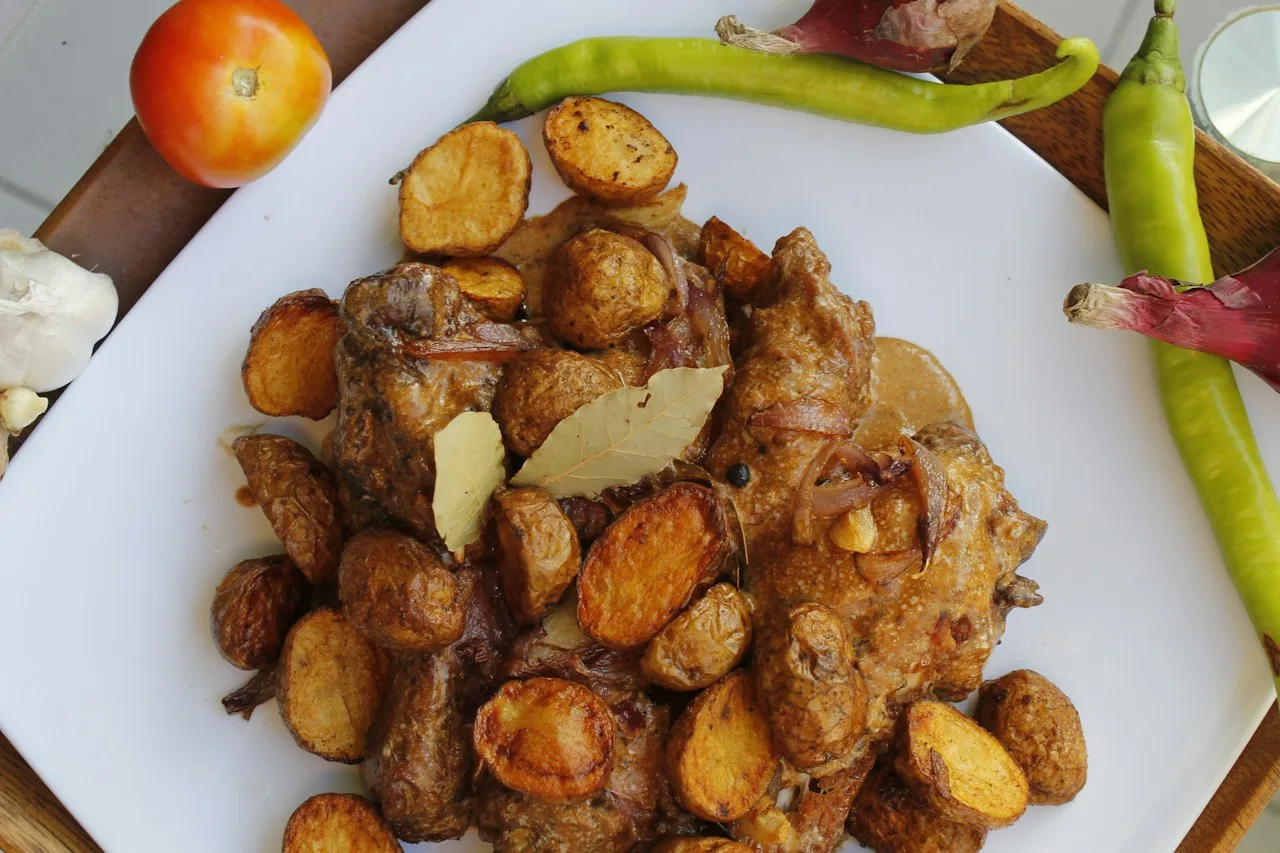
Filipino chicken adobo
Adobo de pollo filipino
Contains allergens
Incomplete allergen information: some ingredients have not been reviewed yet. Always check the labels before cooking.
- Author
- Equipo Cocinoa
- Preparation time
- 116 min
- Servings
- 4
Summary
The Philippines' best-loved stew: chicken thighs simmered in vinegar, soy sauce, lots of garlic, bay leaves and black peppercorns, then reduced to a glossy glaze. With white rice and potatoes that soak up the sauce.
Ingredients
- 80 ml Soy sauce
- 10 cloves Garlic (a whole head, peeled and crushed)
- 3 u Potato (medium, peeled and cut into large chunks) (optional)
- 1 tablespoon Vegetable Oil
- 4 leaves Bay Leaf (dried)
- 1.2 kg Chicken Thighs (bone in, skin on (about 8))
- 2 u Spring Onions (sliced, to serve) (optional)
- 300 g Jasmine Rice
- 1 teaspoon Peppercorns (black, lightly crushed)
- 125 ml White Vinegar (or cane, coconut or cider vinegar)
- 700 ml Water (250 ml for the stew and 450 ml for the rice)
Instructions
Put the chicken in a wide casserole with the soy sauce, garlic, bay leaves and peppercorns. Mix well with your hands and leave for half an hour to take on the flavours (or overnight in the fridge).
30 min
Add the vinegar and 250 ml of water without stirring and bring to the boil over medium-high heat, uncovered. Once it boils, let it bubble for 3 to 4 minutes without touching it, until the sharp smell of the vinegar mellows.
8 min
Lower the heat, add the potatoes if using, half cover and simmer gently, turning the chicken halfway through, until the meat is very tender and starting to come away from the bone.
35 min
Meanwhile, wash the rice until the water runs almost clear and cook it, covered, with 450 ml of water over the lowest heat until it is absorbed. Turn off the heat and leave it to rest, covered, for 10 minutes.
25 min
Lift out the chicken and potatoes with a slotted spoon. Turn up the heat and reduce the sauce, stirring now and then, until it thickens slightly and turns a glossy mahogany colour. Taste it: if it is too salty, loosen it with a little water.
10 min
Heat the oil in a frying pan over medium-high heat and brown the chicken skin side down, along with the potatoes, until the skin is golden and crisp.
6 min
Return the chicken and potatoes to the casserole and turn them in the sauce until glazed. Serve with the rice, plenty of sauce spooned over and the spring onion.
2 min
Notes
Adobo is a Spanish word, but the technique predates the arrival of the Spanish in the Philippines: cooking meat in vinegar and salt was a way of preserving it in a tropical climate, and the newcomers named it after a marinade they knew. Soy sauce came later, brought by Chinese traders, and today every family swears by its own ratio. The rule repeated in Filipino kitchens is not to stir or cover the pot while the vinegar comes to the boil: that way its sharpest edge evaporates and the flavour turns mellow; stir too early and the stew tastes of raw vinegar. In the Philippines cane vinegar (sukang maasim) or coconut vinegar is used; cider or white wine vinegar are good substitutes, while sherry vinegar is too strong. Many households add potatoes, peeled hard-boiled eggs in the last few minutes or a spoonful of brown sugar to balance the acidity; others finish by browning the chicken in a frying pan before returning it to the reduced sauce, which is how it is done here. The chicken must reach 75 °C next to the bone. Like all vinegar-based stews, it is better the next day: it keeps for 4 days in the fridge and freezes for up to 3 months.
More information
Guide indicatorsDifficulty, quality and data reliability
Guide indicators
- Estimated difficulty60/100
- Recipe completeness60/100
- Nutrition reliability
- High
Calculated automatically from the ingredients, steps, time and community feedback. They are not a guarantee.
StorageKeeps 4 days in the fridge
I made this
Have you made it? Tell us how it went.
Community versions
Would you change something? Publish your version: it will link back to this recipe.
Comments
Log in to leave a comment.
No comments yet
Be the first to comment on this recipe.