Cooking techniques
Pulses from start to finish: soaking, cooking and storing
How long to soak each pulse, how long to cook it in an ordinary pot or a pressure cooker, when to add the salt and how to store it so it lasts all week.
By Equipo Cocinoa · 2026-10-23
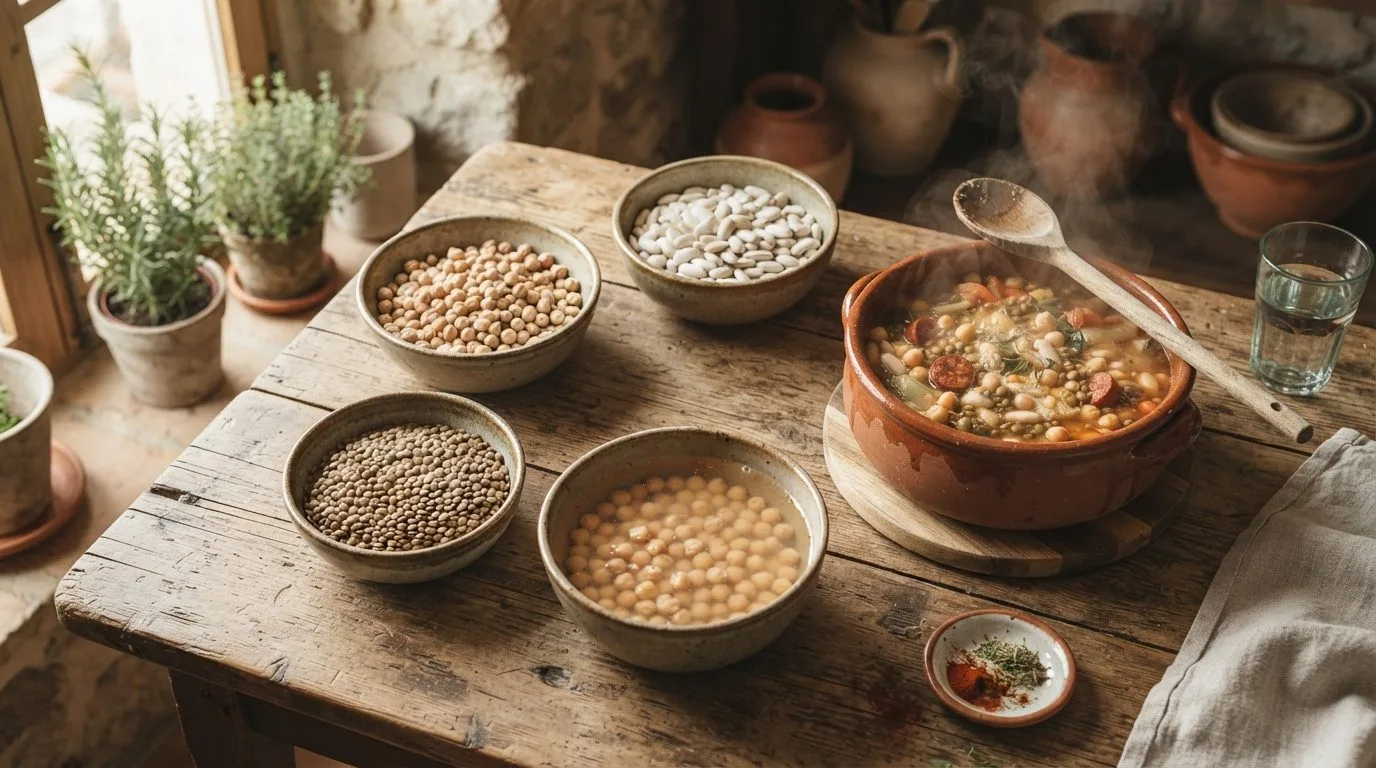
Pulses are among the most rewarding things you can keep in a kitchen: they are cheap, they last for months in the cupboard, they taste even better the next day and they go with almost anything. All they ask is a little forward planning. This guide walks you through the whole process, from the dried packet to the container in the fridge.
Before you start: choose and measure
- Check the date on the packet. Very old pulses take much longer to cook and sometimes never soften completely, however long you give them.
- Don't mix different packets in the same pot. Each batch can have its own cooking time, and you would end up with some beans falling apart next to others that are still hard.
- Pick them over on a tray. Every so often you will find a small stone or a black or shrivelled bean that is best removed.
- Work out the quantities. For a main course, allow about 70–80 g of dried pulses per person; as a side or in a salad, 40–50 g. Once cooked they weigh two and a half to three times as much.
Soaking: which pulses need it and for how long
Soaking hydrates the beans so they cook more evenly and more quickly. Not all pulses need it:
- Chickpeas: between 10 and 12 hours. They do best when the soaking water is lukewarm, never hot.
- White, pinto and red beans, and fabes (large Asturian white beans): between 8 and 12 hours in cold water.
- Pardina, castellana or blond lentils: no need. If you soak them for a couple of hours they cook a little faster, but it isn't essential.
- Red or coral lentils and dried split peas: no soaking. Red lentils break down in 15–20 minutes, which makes them ideal for creamy soups.
Use a large container with at least three times their volume in water, because they swell a lot. If the weather is warm or the soak is going to be a long one, leave them in the fridge so they don't ferment. When they are done, throw away the soaking water and rinse them.
Forgot to put them to soak? There is a quick soak: cover the pulses with plenty of water, bring it to the boil, let them boil for 2–3 minutes, turn off the heat and leave them to stand, covered, for an hour. Then drain and cook as usual. It works with beans and chickpeas, although the skins tend to stay a little less intact.
If the water where you live is very hard (full of limescale), a pinch of bicarbonate of soda in the soaking water helps to soften the skins. Don't use more than half a teaspoon per litre: any more leaves a soapy aftertaste and a pasty texture.
Cooking in an ordinary pot
These times are a guide and are counted from when the water comes to the boil, over a gentle heat. They depend a great deal on the variety and on how fresh the pulses are, so always taste a few before you call the stew done:
- Pardina lentils: 25–35 minutes.
- Castellana or blond lentils: 40–50 minutes.
- Soaked chickpeas: 2 to 3 hours.
- Soaked white or pinto beans: 1½ to 2½ hours.
- Soaked fabes: 2 to 3 hours.
A few tips that make all the difference:
- A gentle simmer, not a rolling boil. With the water boiling furiously, the beans lose their skins and break up. It is enough for the surface to tremble with just a few bubbles rising.
- Chickpeas into hot water. The custom is to add them once the water is already boiling. And if you need to top up with water halfway through, make sure it is hot so you don't interrupt the boil.
- "Shocking" the beans. In traditional bean recipes the boil is interrupted two or three times with a splash of cold water. It helps them cook evenly without splitting.
- Move the pot, not the spoon. Instead of stirring, take hold of the pot by its handles and swirl it: the broth thickens without breaking the beans.
- Red kidney beans: always a good hard boil. Raw, they contain a substance that can make you ill, which is destroyed by a vigorous boil of at least 10 minutes. If you are going to finish them in a slow cooker, boil them for those 10 minutes first.
The pressure cooker
For pulses, a pressure cooker is a great ally: it turns three hours of chickpeas into little more than twenty minutes. Approximate times from when the valve shows the cooker is up to pressure:
- Pardina lentils: 8–10 minutes.
- Castellana lentils: 10–12 minutes.
- Soaked chickpeas: 20–25 minutes.
- Soaked beans: 15–25 minutes.
Fill it no more than halfway, because pulses produce foam that can block the valve. When the time is up, let the pressure come down on its own for about ten minutes: if you force it open, the beans break up and the foam spurts out of the valve. Every cooker is different, so your own manual has the final say. If they are still not tender when you open it, finish cooking them for a few minutes over a gentle heat with the lid off.
Salt, tomato and vinegar
One of the most widespread myths is that salt makes pulses tough. In practice, salting at the start or halfway through doesn't stop them softening, and it means the beans are seasoned all the way through. What really does slow down softening is acidic ingredients such as tomato, wine or vinegar, and sugar in any quantity. That is why it is best to add a tomato sofrito or vinegar when the pulses are already almost tender.
If the stew includes chorizo, morcilla (Spanish black pudding), salt pork or ham, they already bring plenty of salt: taste the broth before adjusting.
The foam
As the water starts to boil, a whitish foam appears. It is made of proteins and other substances released from the beans by the heat; it isn't harmful, but it clouds the broth and gives it a slightly rough edge. Skim it off with a slotted spoon during the first 10–15 minutes and then forget about it.
If you find them hard to digest
Some people find pulses heavy going. It usually helps to always throw away the soaking water, to cook them until they are really tender and, if you don't eat them often, to start with small portions and build up gradually. Red lentils and skinless pulses tend to be easier on the stomach.
Storing them
- In the fridge: cooked and in a closed container, 3 to 4 days. Keep them in their cooking liquid so they don't dry out.
- In the freezer: in their liquid and in portions, for up to about 3 months at good quality. Thaw them in the fridge the night before.
- Dried: in a closed jar, somewhere dry, cool and dark. They keep for a long time, but the longer they are stored, the harder they are to cook.
- Tinned or jarred: these are already cooked. Drain them and rinse them under the tap to get rid of the thick liquid and some of the salt. They are a perfectly good alternative for days when you are short of time.
Cooking a whole kilo of chickpeas in one go and freezing it in portions is one of the best tricks for eating pulses often without having to think about soaking every time.
Common mistakes and how to fix them
- Still hard after hours. It is almost always old pulses or very hard water. Keep cooking, add hot water if needed and, next time, look for a more recent packet or try bicarbonate of soda in the soaking water.
- They have broken up and the broth looks like a purée. The heat was too high or they were stirred too much. Make the most of it: blend some of it and you have a creamy soup.
- The broth is watery. Take out a ladleful of pulses, mash them with a fork and return them to the pot. Five minutes of gentle simmering and the broth will thicken.
- They have stuck to the bottom. Don't scrape. Carefully transfer what is on top to another pot and leave the stuck part where it is.
- They taste bland. A sofrito stirred in at the end, a pinch of pimentón (Spanish paprika) or cumin, or a few drops of vinegar on the plate will wake them up.
Recipes to practise with
- Lentils stewed with chorizo, the everyday classic.
- Chickpeas with spinach, perfect with chickpeas you have already cooked.
- Fabada asturiana, to practise a gentle simmer.
- Pochas a la navarra: pochas are fresh white beans, so they don't need soaking.
- Lentil salad, for when the heat is on.
For information only. It does not replace advice from a health professional.
More posts
Cooking techniques
Sofrito: how to get the foundation of Spanish cooking right
Timing, heat and the order of the ingredients for a sofrito that really brings flavour: softened or caramelised onion, well-reduced tomato and how to store it.
Equipo Cocinoa · 2026-10-23
Cooking techniques
Dry, creamy or soupy rice: ratios, timings and common mistakes
Which variety to choose, how much stock each style of rice needs, paella pan or casserole, how to get the socarrat and how to store leftover rice safely.
Equipo Cocinoa · 2026-10-23
Cooking techniques
Homemade stocks and broths: chicken, vegetable and fish
Which bones and vegetables to use, how long to simmer each stock, how to skim off the fat and how to freeze it in portions so you always have some to hand.
Equipo Cocinoa · 2026-10-23